A Digital Nomad's Guide to Working Remotely in Southeast Asia
If you can do your job with a laptop and an internet connection, working remotely can mean working from almost anywhere. Some remote workers, often called digital nomads, take advantage of that flexibility to live and work in different places. Southeast Asia has become a popular region for doing just that, with Thailand, Malaysia, Indonesia, and the Philippines each establishing dedicated visa programs to attract remote workers.
But before booking a month in Bali or setting up shop in Bangkok, you need to know: is the internet good enough to get you through a normal workday?
Speedtest Intelligence® data from 13 destinations across six Southeast Asian markets indicates the answer is generally yes. Both mobile and fixed broadband should offer plenty of speed for typical remote work, although performance varies between places, particularly on fixed broadband.
Read on for what you should know before you go, or for a deeper look at the data, check out our Ookla Research article, 5G Reaches Every ASEAN Digital Nomad Hub as Performance Margins Narrow.
Mobile connectivity for remote work in Southeast Asia: what to expect
For digital nomads, mobile connectivity can be especially important. You may be working somewhere without a fixed broadband connection, or need to fall back on your phone when the Wi-Fi at a hotel, rental, or coworking space isn't performing well.
The good news is that mobile performance across the areas we analyzed should be more than sufficient for a typical remote workday. Here’s what the data shows:
Mobile speeds should easily support remote work: Speedtest data found that median mobile download speeds ranged from 55.48 Mbps in Cebu to 215.56 Mbps in Da Nang. For context, Microsoft notes that Teams can provide HD video calls with less than 1.5 Mbps of bandwidth.
Video calls should perform well: Video calls should perform well: Microsoft lists jitter, the variation in connection delays that can disrupt calls, below 30 ms as typical for Teams audio. All 13 locations were comfortably below that mark, ranging from just 7 ms in Da Nang to 18 ms in Cebu.
5G is widely available: According to Speedtest data, people with 5G-capable devices were able to access 5G across every area analyzed, with 5G Availability ranging from 40% in Penang to nearly 84% in Phuket. Ookla’s Consistency metric measures the share of samples that meet a minimum speed threshold, and across all 13 locations, at least 75% of 5G samples met that 25 Mbps download and 3 Mbps upload benchmark.
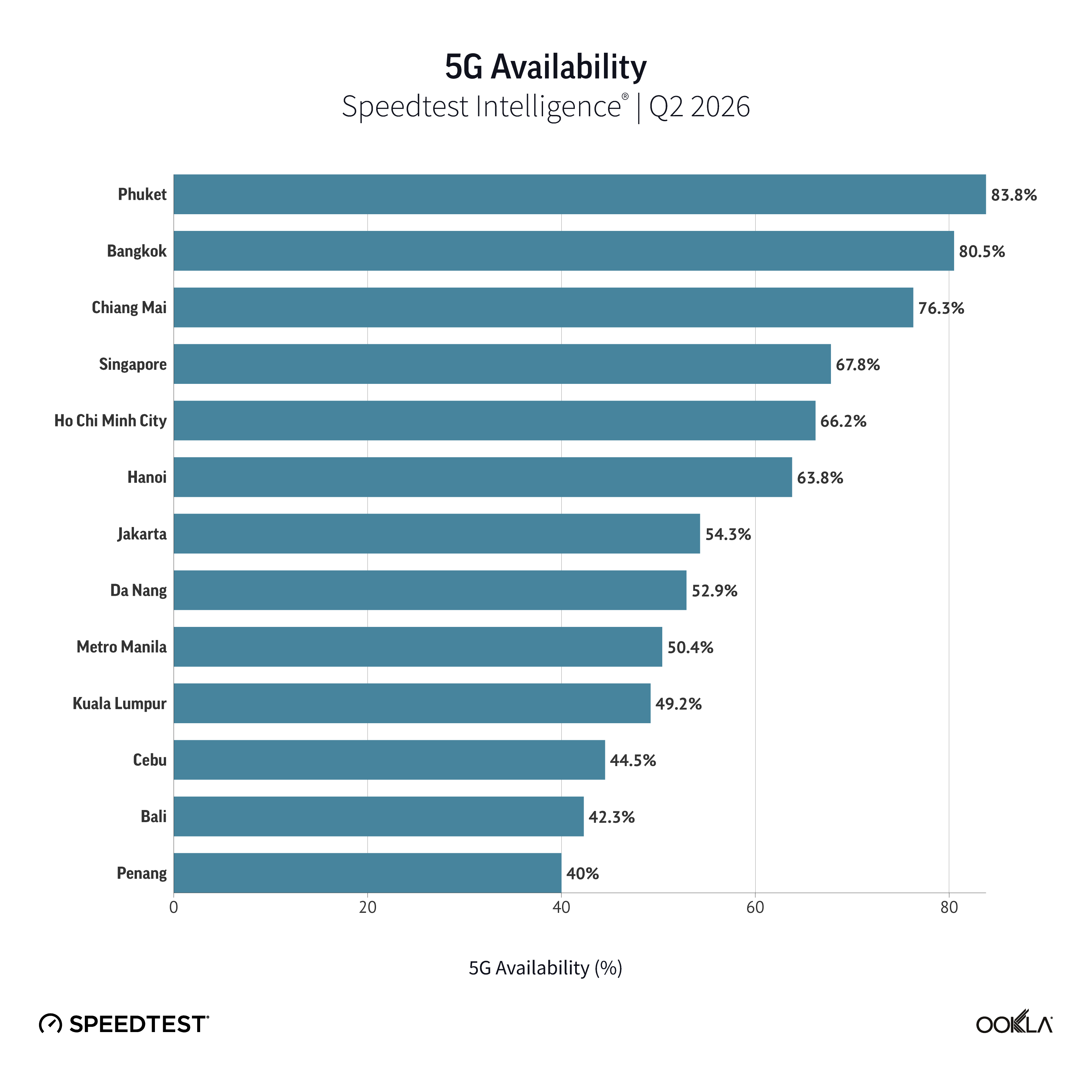
5G Availability, Speedtest Intelligence, Q2 2026
- Phuket: 83.8%
- Bangkok: 80.5%
- Chiang Mai: 76.3%
- Singapore: 67.8%
- Ho Chi Minh City: 66.2%
- Hanoi: 63.8%
- Jakarta: 54.3%
- Da Nang: 52.9%
- Metro Manila: 50.4%
- Kuala Lumpur: 49.2%
- Cebu: 44.5%
- Bali: 42.3%
- Penang: 40%
Don’t assume your rental will have good Wi-Fi
Fixed broadband also delivered plenty of speed for remote work across most of the 13 places we analyzed, but performance varied considerably. And even in areas where fixed broadband was fast overall, users didn't always experience those speeds regularly.
Chiang Mai shows why a market’s overall broadband speed can only tell you so much about the connection you’ll get at a particular rental, hotel, or coworking space. While the city’s median download speed topped 250 Mbps, Ookla’s Consistency metric shows that 65.7% of its fixed broadband samples met the 25 Mbps download and 3 Mbps upload threshold, which means that more than one-third of Speedtest users were getting speeds below that threshold.
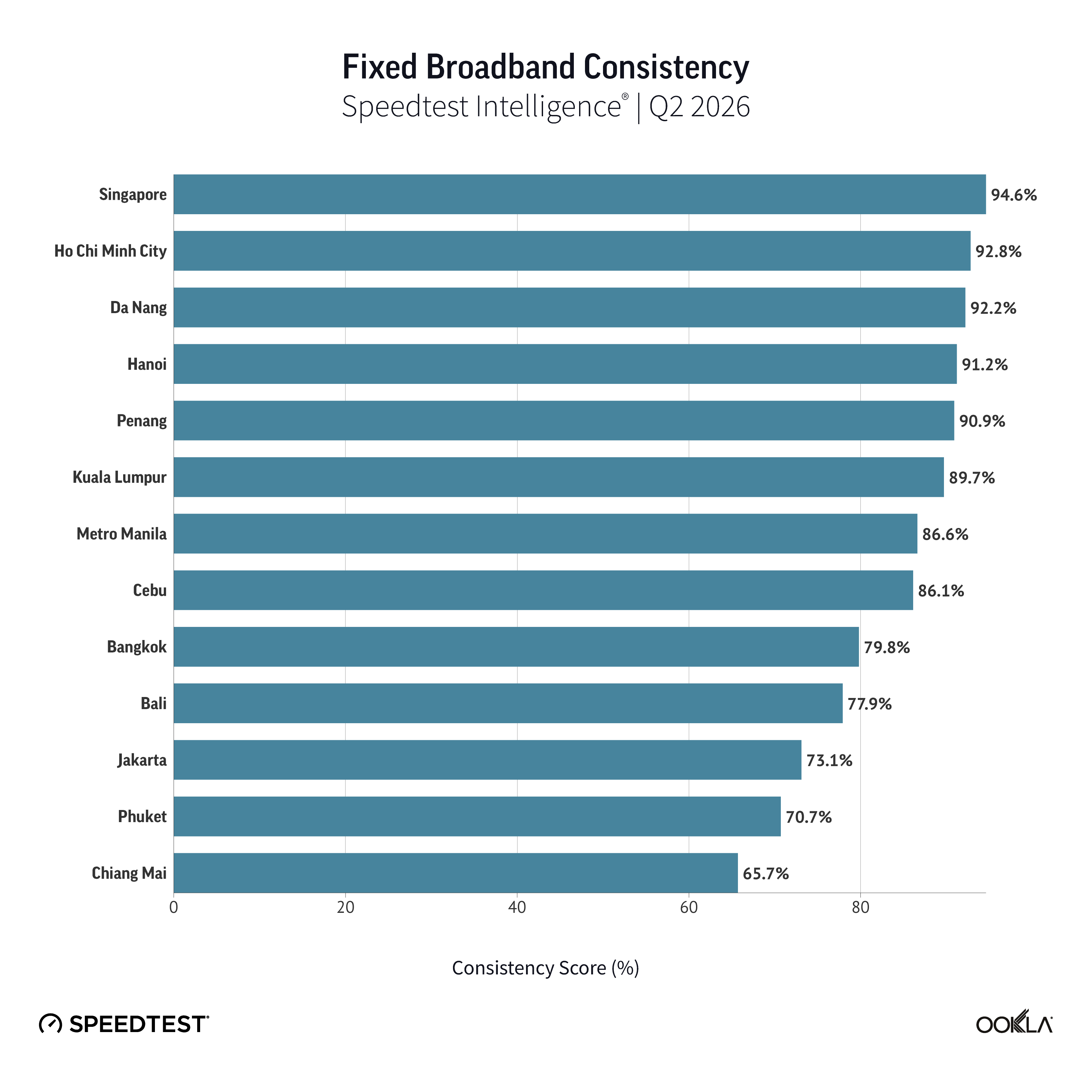
Fixed Broadband Consistency, Speedtest Intelligence, Q2 2026
- Singapore: 94.6%
- Ho Chi Minh City: 92.8%
- Da Nang: 92.2%
- Hanoi: 91.2%
- Penang: 90.9%
- Kuala Lumpur: 89.7%
- Metro Manila: 86.6%
- Cebu: 86.1%
- Bangkok: 79.8%
- Bali: 77.9%
- Jakarta: 73.1%
- Phuket: 70.7%
- Chiang Mai: 65.7%
Speedtest data also points to a few other things worth considering before settling on a spot for an extended remote-work stay:
Fixed speeds vary widely between destinations: Singapore recorded a median fixed download speed of 447.75 Mbps, while Jakarta clocked in at 60.33 Mbps. Both should be strong enough for typical remote work, but the difference shows just how much fixed broadband performance can vary across the region.
Older Wi-Fi equipment can limit your speeds: A fast broadband connection can still be slowed down by an older router or access point, so the Wi-Fi equipment at your rental can affect how much of that speed actually reaches your device. For instance, roughly 42% of Wi-Fi connections observed in Bali and Jakarta used the older Wi-Fi 4 standard.
If you're planning a longer stay, consider asking your host, hotel, or coworking space for a recent Speedtest result rather than merely confirming that Wi-Fi is available.
Have a backup plan for getting online (hint: think mobile)
You’ve checked the broadband speeds at your destination and even asked your host for a Speedtest result. Everything looks great. But connections can still have problems, so it pays to have a backup. If the Wi-Fi isn't performing well, turning your phone into a mobile hotspot can give your laptop another way to get online.
Your phone should serve as a strong backup in the region. In seven of the 13 locations Ookla studied, 5G had a higher Consistency score than fixed broadband. Chiang Mai showed one of the largest differences, with 87.5% of the city's 5G samples meeting Ookla’s 25 Mbps download and 3 Mbps upload threshold compared with 65.7% of fixed broadband samples.
Ready to work remotely from Southeast Asia?
All 13 markets analyzed had mobile jitter comfortably below the 30 ms level Microsoft considers typical for Teams audio calls, while median fixed download speeds exceeded 100 Mbps in 11 of the 13. Still, the experience at an individual rental, hotel, or coworking space can vary, particularly when it comes to fixed broadband.
Before booking a longer stay, confirm what kind of connection you'll actually have rather than simply assuming the Wi-Fi will meet your needs. And make sure you understand the mobile options available at your destination in case you need a backup.
For a closer look at all 13 destinations, read our full Ookla Research analysis, 5G Reaches Every ASEAN Digital Nomad Hub as Performance Margins Narrow.